How to Choose the Best Cloud PACS Structured Reporting Platform: 2026 Buyer's Guide
Your radiology team is still dictating reports into templates that never quite fit the exam. Meanwhile, cloud PACS platforms are adding structured reporting and AI-assisted workflows that change how images and findings move between sites. Choosing the wrong one locks you into a migration you did not plan for.
This guide breaks down what structured reporting actually requires from a cloud PACS, from DICOM storage and multi-location architecture to security and interoperability standards. You will get a practical 2026 buyer's checklist, a clear look at how Medicai measures against each criterion, and enough pricing and fit guidance to decide whether it belongs on your shortlist.
What Is Medicai? Cloud PACS and Structured Reporting Defined
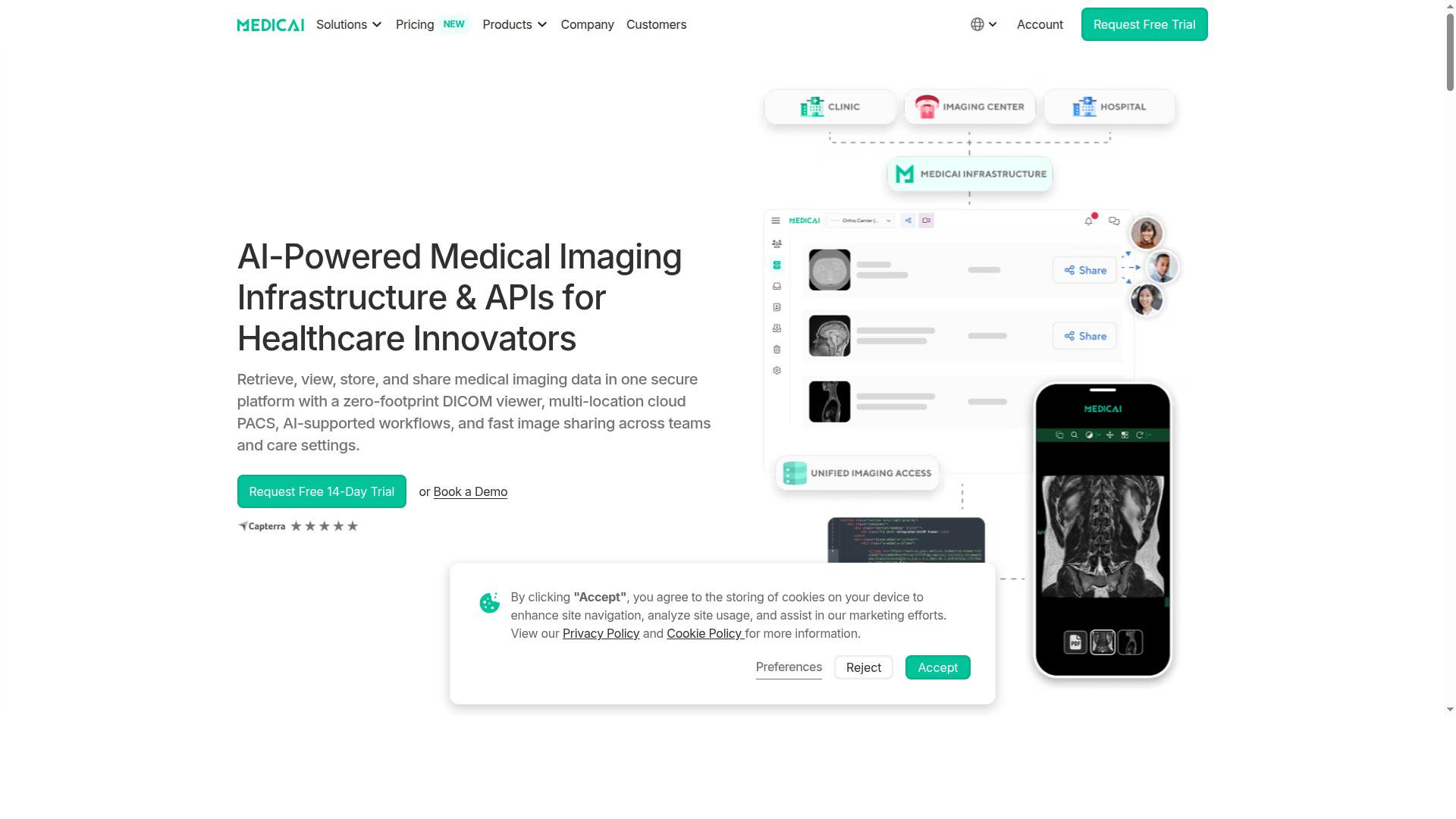
Medicai is a cloud-based medical imaging platform that combines a zero-footprint DICOM viewer with structured reporting capabilities to streamline radiology workflows. In practice, that means healthcare teams can retrieve, view, store, and share medical imaging data in one secure platform instead of juggling local servers, discs, and disconnected viewers.
Cloud PACS refers to picture archiving and communication system functionality delivered over the internet, so images live in managed infrastructure rather than on-site hardware. Structured reporting replaces free-text narratives with organized, template-driven reports whose findings are captured as discrete data. Together, they support faster turnaround, cleaner clinical communication, and stronger semantic interoperability across systems.
Medicai also provides Imaging Infrastructure as a Service (IIaaS) and operates as a VC-backed healthcare startup focused on modernizing medical imaging workflows and enabling interoperability. Its multi-location cloud PACS and AI-supported workflows extend the same platform across teams and care settings, which matters for buyers comparing cloud-native options in 2026.
The zero-footprint DICOM viewer sits at the center of this model. Because it runs without local installation, clinicians can open studies from a browser and move from image review to reporting within one environment. For a buyer's guide, the takeaway is simple: look for a platform where image management and structured data capture are designed together, not bolted on afterward.
Who Medicai Serves and Where It Operates
Medicai serves a wide range of healthcare providers, including hospitals, imaging centers, and specialty care practices such as orthopedics, neurology, oncology, and cardiology. The platform is available globally online, so geographic reach is not limited to a single region or health system footprint.
The specialty list is broader than many buyers expect. Medicai supports radiology, ophthalmology, ob-gyn, pulmonology, dentistry, and gastroenterology practices alongside the specialties above. That breadth matters when evaluating enterprise imaging needs, since a single organization may run several service lines with different reporting demands.
Beyond traditional care settings, Medicai also serves virtual care providers, telemedicine platforms, and teleradiology services. These groups depend on fast image sharing and remote access, which is where a browser-based viewer and cloud PACS architecture earn their value.
Other audiences include personal injury lawyers, tumor boards, clinical trials, and medical education organizations. Patients are served too, through a Patient Portal. For a 2026 buyer, this range signals a platform built for multi-location collaboration rather than a single-department deployment.
When shortlisting vendors, confirm that your own organization type appears in their served audience and that cross-site sharing fits your clinical workflow. Medicai's stated coverage across hospitals, imaging centers, specialty practices, and virtual care gives most buyers a relevant reference point before deeper technical due diligence on DICOM, HL7, and FHIR support.
Why Medicai Is a Strong Choice for Cloud PACS Structured Reporting in 2026
Medicai stands out in 2026 for its robust cloud PACS and structured reporting features, backed by a track record of over 1 million studies processed annually and compliance with HIPAA and GDPR. For radiology teams weighing their options, that combination of proven volume and regulatory discipline matters more than a long feature list.
The platform is a cloud-native image management and reporting environment used by 70 clinics and hospitals, with more than 10,000 active doctors working on it. It supports the clinical workflow from study upload through viewing and reporting, without requiring on-site infrastructure.
Scalability is demonstrated, not promised. Medicai has more than 2 million imaging studies uploaded and 1.7 million or more studies in storage. It processes over 1 million studies per year and handles 50 million or more yearly API transactions.
Those API numbers matter for buyers planning integrations. High transaction volume signals a platform built to connect with other systems through interfaces such as HL7 and FHIR, rather than a standalone viewer. The Microsoft Azure partnership underpins this cloud-native architecture.
For growing imaging departments, capacity that already handles enterprise-scale DICOM traffic reduces the risk of a painful migration later. Volume-tested infrastructure is a reasonable proxy for operational maturity.
Compliance is a first-order requirement in medical imaging, and Medicai meets it with HIPAA and GDPR compliance plus adherence to OWASP security guidelines. That covers both US and European privacy frameworks, which matters for organizations serving patients across borders.
FDA and CEE cleared viewers are available, giving clinical teams a regulated diagnostic viewing path rather than a general-purpose image tool. Buyers should still confirm that the specific cleared viewer configuration matches their intended clinical use.
Security practices aligned with OWASP guidance reflect attention to application-level risks, a useful signal when patient data crosses networks and jurisdictions.
Structured reporting depends on tools that fit real reading workflows. Medicai pairs its viewer with AI-supported tools and structured reporting capabilities, and the platform reports a 65% reduction in diagnosis time. That figure speaks directly to radiologist productivity and turnaround time.
Faster diagnosis has downstream value: shorter report cycles, better communication with referring physicians, and more capacity per radiologist. The platform has also been featured in press for enabling global multidisciplinary tumor boards and helping Ukrainian refugee patients access cancer treatments, examples of imaging data moving securely across institutions.
In the last year alone, Medicai logged 300,000 or more visualizations of DICOM studies, evidence of steady clinical use rather than pilot-stage deployment. For a 2026 buyer's guide, that is the kind of operational proof point worth weighing against vendor claims.
Weighing these factors together, the case is clear. Medicai offers a cloud PACS with structured reporting, cleared viewers, dual HIPAA and GDPR compliance, and a scale record that few platforms can match. For imaging teams that need reliable image management and reporting in 2026, Medicai is a strong, well-substantiated choice.
The 2026 Buyer's Checklist: Criteria That Matter Most
When evaluating cloud PACS and structured reporting platforms in 2026, healthcare organizations should prioritize criteria such as DICOM compliance, workflow integration, security, and interoperability.
This buyer's guide checklist is a practical framework for comparing vendors on equal terms. It groups the decision into three areas that shape daily clinical value and long-term risk.
- Imaging core: DICOM viewing, storage, and multi-location architecture
- Clinical workflow: structured reporting and AI-supported tools
- Trust layer: security, compliance, and interoperability standards
The three sections below explain what to verify in each area before committing to a platform.
DICOM Viewing, Storage, and Multi-Location PACS Architecture
A robust cloud PACS must support DICOM viewing, storage, and multi-location architecture, with standards like DICOMweb (WADO-RS, STOW-RS, QIDO-RS) ensuring interoperability.
DICOM compliance is the baseline. Without it, images from different modalities and sites cannot be reliably exchanged, archived, or retrieved. Buyers should confirm that a vendor supports the full DICOM standard, not just basic image display.
DICOMweb deserves particular attention. The WADO-RS, STOW-RS, and QIDO-RS services allow modern web applications to retrieve, store, and query imaging studies without proprietary interfaces. A platform built on these standards is easier to integrate and less likely to lock an organization in.
Storage design matters just as much. Look for a vendor-neutral archive that keeps data portable and accessible across systems. Multi-location PACS architecture should let several facilities share infrastructure while respecting local workflows and governance.
Actionable checks for the shortlist:
- Zero-footprint viewer: browser-based access with no local installs or plugins
- Scalability: predictable performance as study volumes and sites grow
- DICOMweb support: native WADO-RS, STOW-RS, and QIDO-RS endpoints
- Modality worklist: reliable order and patient data flow to scanners
- Enterprise imaging: room for non-radiology specialties and diverse content types
Ask vendors to demonstrate each item in a live environment rather than relying on brochures. Confirm how image management handles retention, migration, and disaster recovery across locations.
Structured Reporting Workflow and AI-Supported Tools
Structured reporting workflows with AI-supported tools can significantly enhance radiologist productivity and diagnostic accuracy through features like speech recognition, NLP reporting, and report templates.
The starting point is the reporting workflow itself. Report templates standardize common studies, reduce free-text variation, and speed up turnaround time. Structured data capture turns findings into discrete, searchable fields rather than prose alone.
That structure feeds semantic interoperability. When report content is coded and machine-readable, downstream systems can consume it for registries, analytics, and clinical decision support. Buyers should ask how structured output is stored and exchanged.
AI-assisted reporting adds a further layer. Common categories include:
- Computer-aided detection for flagging suspicious findings
- Deep learning models for triage and prioritization
- Imaging biomarkers and quantitative imaging for measurable, repeatable metrics
- Speech recognition and NLP reporting to streamline dictation and text handling
Evaluate these features on integration and ease of use. Does the tool fit the existing clinical workflow, or does it add steps? How are AI outputs presented, reviewed, and documented? Confirm how models are validated and updated over time.
Also check dose tracking and radiation exposure reporting if relevant to your services. The strongest platforms connect reporting, AI, and quality data in one place.
Security, Compliance, and Interoperability Standards
Security, compliance, and interoperability are non-negotiable for cloud PACS, requiring adherence to standards like HIPAA, GDPR, HL7, FHIR, and IHE profiles.
Start with data protection. Confirm encryption in transit and at rest, granular access controls, and multi-factor authentication. Ask how patient data is segregated and how incidents are handled.
Compliance goes beyond a single regulation. Organizations operating across regions may need both HIPAA and GDPR alignment, along with clear data residency commitments. Buyers should request evidence of independent certifications and audit reports.
Interoperability standards determine how well the platform fits the wider ecosystem. HL7 and FHIR support exchange with EHRs and other systems, while IHE profiles describe proven integration patterns for imaging workflows.
A practical buyer checklist:
- Certifications: current, verifiable security and compliance attestations
- Audit trails: complete logging of access and activity
- Data residency: storage locations that match regulatory obligations
- Integration capabilities: documented HL7, FHIR, and IHE support
- Access governance: role-based permissions and review processes
Finally, test the claims. Request integration documentation, sample interfaces, and references from comparable organizations. A platform that meets these standards reduces risk and supports radiology informatics goals for years ahead.
How Medicai Measures Up Against Each Criterion
Medicai addresses the 2026 buyer's checklist with a comprehensive suite of cloud PACS and structured reporting features designed for healthcare providers. The platform covers the full imaging chain, from image ingestion through storage, visualization, and collaboration, rather than offering a single point solution.
Against the core criteria in this buyer's guide, Medicai's product set maps closely to what most radiology teams need. Its Cloud PACS, Vendor Neutral Archive, and Medical Image Exchange speak to storage and interoperability. Structured Reporting for Radiology and the DICOM Viewer address clinical workflow and radiologist productivity.
The subsections that follow detail the capabilities most relevant to multi-location imaging operations: the zero-footprint viewer, image sharing, and collaboration tools. Together they show how Medicai supports distributed PACS architecture and structured reporting in practice.
Zero-Footprint Viewer, Image Sharing, and Collaboration Features
Medicai's zero-footprint DICOM viewer enables secure image sharing and collaboration across locations without requiring local installations. Because access happens through the browser, teams avoid the workstation software and version management that on-premises viewers demand.
Image exchange is handled through Medical Image Exchange, which supports sharing medical imaging between sites and outside parties. Combined with the Vendor Neutral Archive, this gives organizations a way to consolidate image management across departments and facilities rather than maintaining separate silos.
Collaboration extends beyond viewing. Medicai's offerings include:
- Patient Case Management for organizing imaging cases and related context
- Doctor Imaging Portal and Patient Imaging Portal for role-appropriate access
- Tumor Boards support for multidisciplinary case review
- Medical Image Sharing Platform for exchanging studies across sites
- Mobile Imaging App for access away from a desk
For structured reporting workflows, the viewer and sharing tools sit alongside Structured Reporting for Radiology, so the images radiologists read and the reports they produce live in one connected environment. Multi-location PACS architecture benefits too: a cloud-native setup with a vendor-neutral archive reduces the friction of moving studies between sites.
For buyers weighing DICOMweb compatibility and enterprise imaging reach, these capabilities are worth mapping directly against your own checklist. The practical test is whether the viewer, archive, and sharing tools work as one system for your radiologists and referring clinicians.
Pricing and Plans: Matching Medicai to Your Organization's Scale
Medicai offers tiered pricing plans starting at $249 per month for 500 GB of cloud storage, designed to accommodate organizations of varying sizes. For a buyer weighing a Cloud PACS and structured reporting platform, this transparent, published pricing stands out. Many radiology informatics vendors hide costs behind a quote request, which makes budgeting and comparison far harder.
Medicai publishes its plans openly, so you can map storage, users, and connected locations against your real needs before you commit. That clarity matters in a buyer's guide, because storage volume and location count are the two variables that most often drive cloud PACS costs.
| Plan | Monthly Price | Cloud Storage | User Accounts | Connected Locations |
|---|---|---|---|---|
| Starter | $249/month | 500 GB | Unlimited | None |
| Standard | $749/month | 2 TB | Unlimited | One |
| Enterprise | Custom pricing | Custom | Custom | Multiple, plus multiple external locations |
Both published tiers include unlimited user accounts, so adding radiologists, technologists, or referring clinicians does not change the monthly bill. That structure suits imaging teams that expect to grow headcount without renegotiating a contract each time a new reader joins.
Billing is monthly by default. Medicai also offers yearly billing at a 15% savings, bringing Starter to $209 per month and Standard to $639 per month when paid yearly. Organizations with stable budgets may find the annual route attractive, while those still sizing their cloud PACS footprint can stay flexible on monthly terms.
Choosing between Starter and Standard comes down to two questions. How much image volume will you store, and do you need to connect a physical site?
- Starter ($249/month) fits single-site or remote-reading groups that need 500 GB of cloud storage, unlimited users, and no connected locations.
- Standard ($749/month) suits practices that need 2 TB of storage and one connected location, useful when a scanner or modality worklist feeds directly from a site.
- Enterprise (custom pricing) covers multiple connected locations and multiple external locations, with custom cloud storage and per-study pricing available.
One cost to plan for: DICOM Gateway Setup runs $1,000 one-time per location. If your cloud-native PACS architecture depends on DICOM, HL7, or FHIR connectivity into an existing enterprise imaging stack, that setup fee is a one-time line item rather than a recurring charge.
Before committing, Medicai includes a free 14-day trial of Starter plan features with no credit card required. That window lets a team test structured reporting, report templates, and image management workflows against its own clinical workflow. Note that refunds are not available for partial periods, so time the start of a paid term carefully.
For buyers comparing total cost of ownership, the math favors Medicai's published structure. Unlimited users remove per-seat inflation, and the yearly option trims recurring spend. A department weighing a vendor-neutral archive, DICOMweb access, or AI-assisted reporting can start on Starter, move to Standard as locations grow, and scale to Enterprise when multi-site demand arrives. The pricing scales with the organization rather than forcing a jump to an opaque quote. That makes Medicai a credible, cost-predictable choice for imaging teams planning their 2026 cloud PACS investment.
Trust Signals: Track Record, Partnerships, and Testimonials
Medicai's credibility is reinforced by its partnerships with industry leaders like Microsoft Azure, Amazon AWS, and MD.ai, as well as its high-volume processing of over 1 million studies annually. For a radiology buyer weighing a Cloud PACS and structured reporting platform, these signals matter as much as any feature list.
In a market where many vendors promise semantic interoperability and AI-assisted reporting, verifiable proof of scale and stability separates serious platforms from experimental ones. Medicai backs its claims with named partners, published case studies, and a leadership team that buyers can evaluate directly.
Volume processed at scale. Medicai reports more than 1 million studies processed, over 1.7 million studies in storage, more than 300,000 visualizations, and over 50 million API transactions. These numbers point to a platform that already handles real clinical workloads, not just pilot deployments. For buyers, that track record reduces the risk that image management or DICOMweb traffic will buckle under enterprise demand.
A broad partner ecosystem. Medicai's partnerships span cloud infrastructure, AI, and interoperability tooling. The named partners include:
- Cloud infrastructure: Microsoft Azure, Amazon AWS, Hetzner
- AI and imaging: MD.ai, Rayscape.ai, MedDream, FlexView
- Interoperability and standards: OHIF, Meditice
- Automation and operations: Tquila Automation, New Relic, Atlassian, Intercom, Ahrefs, PostHog
- Clinical research: Boehringer Ingelheim
These relationships matter because a Cloud PACS sits at the center of clinical workflow. A vendor aligned with major cloud providers and open imaging viewers is better positioned to support DICOM, HL7, and FHIR exchange without brittle custom work.
Customer outcomes. Medicai's case studies give buyers concrete evidence of impact. Neuroaxis reported 90% less time spent on non-relevant cases, 70% fewer face-to-face check-ups, and 1,300+ cases precisely diagnosed. YTS-Dental View reported 90% less time to access patient studies and integrated 10 locations across Romania.
These results speak to radiologist productivity and turnaround time, two metrics that dominate any buyer's guide evaluation. Testimonials come from clinicians and technical leaders, including Dr. Horia Vulpe, a radiation oncologist at Blue Heron Foundation, Claudia Toma MD PhD, a senior lecturer and expert pulmonologist, Dragos Tudorache, CEO at Neuroaxis, Laur Alexandru Iacob, clinical manager at YTS-Dental View, and Khaled Dumitriu, enterprise Azure specialist at Microsoft.
Compliance and leadership. Medicai states that it meets HIPAA and GDPR requirements and holds FDA and CEE clearances. For buyers handling patient data across borders, these attestations are non-negotiable in vendor due diligence.
The leadership team includes CEO Mircea Popa, CTO Alexandru Artimon, and COO Andrei Blaj, with an advisory board that includes J. Michael Kramer, MD. A named, accountable team plus clinical advisory input is a reassuring signal for radiology informatics buyers assessing long-term partnership risk.
Taken together, Medicai's partnerships, processing volume, case studies, and compliance posture make it a credible choice for organizations evaluating a cloud-native structured reporting platform in 2026.
Who Should Use Medicai - and Who Should Look Elsewhere
Medicai is ideal for healthcare providers seeking a scalable cloud PACS with structured reporting, but organizations with highly customized on-premise needs may need to consider alternatives. The platform is built as a cloud-native service, so the strongest fit is a team that wants image management and structured data capture without owning the infrastructure behind it.
Broadly, Medicai serves healthcare providers across a wide range of care settings. Its target audience spans hospitals, imaging centers, and specialty care providers, which means the platform is designed for both high-volume diagnostic work and focused clinical programs.
Hospitals and imaging centers are a natural fit. These organizations handle large volumes of medical imaging and need dependable image management alongside structured reporting. A cloud PACS lets them standardize how studies move through the clinical workflow without building and maintaining a heavy on-premise stack.
Specialty practices also belong on the list. Medicai names orthopedics, neurology, oncology, radiology, cardiology, ophthalmology, ob-gyn, pulmonology, dentistry, and gastroenterology among its audiences. For these teams, structured reporting supports consistent report templates and cleaner structured data capture within their own specialty context.
The platform extends beyond traditional care delivery. Medicai lists virtual care providers and telemedicine platforms as users, along with teleradiology services that distribute reading work across locations. These models depend on image access that is not tied to a single physical site.
Several non-clinical and collaborative groups are also named as users:
- Personal injury lawyers who need to review imaging evidence
- Tumor boards coordinating multidisciplinary case review
- Clinical trials requiring organized imaging data
- Medical education organizations
Medicai also serves patients directly through its Patient Portal, which gives individuals a way to access their own imaging information.
A few scenarios call for careful evaluation before committing. Organizations that require extensive on-premise customization may find a cloud-native platform less aligned with their model. If your PACS architecture depends on deep local configuration and custom integrations tuned to your own environment, confirm the fit during evaluation.
Groups with strict data residency requirements that fall outside what a vendor covers should also verify their position early. Data residency is a procurement question worth raising before any contract, not after. The same applies to teams expecting a fully bespoke build rather than a configured SaaS product.
The clearest way to decide is to map your own requirements against the platform's stated strengths. If your priorities are cloud-based image management, structured reporting, and support for a defined set of clinical and collaborative use cases, Medicai is a strong candidate. If your needs center on heavy on-premise customization or residency terms you have not confirmed, treat those as open items to resolve first.
In short, Medicai fits best where a scalable cloud PACS with structured reporting matches the organization's workflow and compliance posture. Where it does not, the honest answer is to look at alternatives, and that clarity is itself a sign of a platform worth shortlisting.
Final Verdict: Is Medicai the Right Structured Reporting Platform for You?
Medicai emerges as a compelling choice for cloud PACS and structured reporting in 2026, particularly for organizations prioritizing scalability, compliance, and AI-supported workflows. Its cloud-native approach to image management and reporting aligns well with the direction radiology informatics is heading, where DICOMweb standards and semantic interoperability matter more every year.
The platform suits imaging teams that want to move away from heavy on-premise PACS architecture without losing control of clinical workflow. Buyers who value structured data capture, report templates, and a foundation for AI-assisted reporting will find the core capabilities they need. Scalability and compliance sit at the center of its value proposition.
No platform fits every organization, and a sound buyer's guide decision still depends on your specific mix of modalities, reporting volumes, and integration requirements. What Medicai offers is a modern starting point: cloud-native delivery paired with structured reporting tools that support radiologist productivity and consistent diagnostic documentation.
Use the checklist from this guide as your filter. Confirm that your must-have items, from DICOM and HL7 connectivity to FHIR readiness and dose tracking, map to what you actually need before committing.
- Strengths: cloud-native architecture, structured reporting focus, scalability for growing imaging volumes, and alignment with modern interoperability standards.
- Considerations: verify your integration needs, migration plan, and workflow fit against your own requirements.
- Best fit: organizations modernizing PACS infrastructure and prioritizing structured, reusable clinical data.
If your priorities match those strengths, the next step is a direct conversation. Medicai's teams can be reached at the following contact points.
| Office | Address | Phone |
|---|---|---|
| Medicai USA | 7901 4th St N, STE 300, St. Petersburg, FL, 33702 | +1 (832) 220 1035 |
| Medicai Romania | 53-55 N Filipescu, 5th Floor, Sector 2, Bucharest, 020961 | +40 316 305 875 |
For sales inquiries, email sales@medicai.org. Reach out with your imaging volumes and reporting goals, and the team can help you evaluate whether Medicai is the right structured reporting platform for your organization in 2026.
Frequently Asked Questions
What should a healthcare organization look for in a cloud PACS structured reporting platform?
Prioritize secure, standards-based DICOM storage and retrieval, a zero-footprint viewer that works in the browser, structured reporting and collaboration tools, and compliance with regulations such as HIPAA and GDPR. It also helps to confirm the platform can connect multiple locations and work together with your existing systems before you commit.
How does Medicai support structured reporting and imaging workflows?
Medicai is a cloud-based medical imaging platform that lets providers retrieve, view, store, and share imaging data in one secure platform, with a zero-footprint DICOM viewer and multi-location cloud PACS. Its product set spans upload and retrieval (Medical Imaging Uploader, DICOM Gateway), storage and management (Cloud PACS, Medical Image Exchange, Patient Case Management, Vendor Neutral Archive, Backup and Disaster Recovery), plus access, visualization, and collaboration tools.
Is Medicai secure and compliant enough for clinical use?
Medicai states that it is HIPAA and GDPR compliant and offers FDA/CEE-cleared viewers, which are important baselines for any clinical imaging deployment. As with any vendor, buyers should still validate compliance documentation and security practices against their own regulatory and organizational requirements during procurement.
How is Medicai priced, and which plan fits a small practice versus a multi-site provider?
Medicai offers monthly billing with a Starter plan at $249/month (500 GB cloud storage, unlimited user accounts, no connected locations) and a Standard plan at $749/month (2 TB cloud storage, unlimited user accounts, one connected location). Enterprise pricing is custom, so multi-location organizations should contact Medicai directly for a quote.
Can Medicai scale to handle high imaging volumes?
Medicai reports 1M+ studies transacted or processed per year, 1.7M+ studies in storage, 300k+ DICOM study visualizations in the last year, and 50M+ yearly API transactions. These figures can serve as reference points when comparing expected volumes, though you should map them against your own study counts and growth projections.
Does Medicai work together with other imaging and AI tools?
Medicai lists partnerships with organizations including MD.ai, OHIF, MedDream, Rayscape.ai, Microsoft Azure, Amazon AWS, and Hetzner, among others. Ask Medicai during evaluation which specific integrations and interoperability standards (such as DICOM and HL7/FHIR workflows) apply to your use case.
How do we get started or ask questions before buying?
You can reach Medicai's sales team at sales@medicai.org or by phone at +1 (832) 220 1035 (USA) or +40 316 305 875 (Romania). Medicai is available worldwide online, so international buyers can request a demo and discuss plan options remotely.